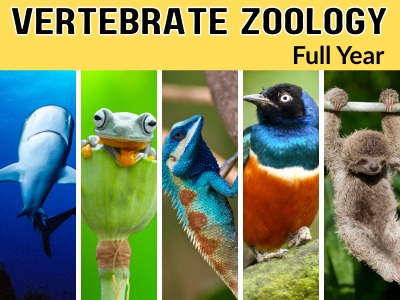
This is Session 2 of 2 in the full year Vertebrate Zoology series
PREREQUISITE: It is required to take Session 1 before you can enroll in Session 2.
CLASS DESCRIPTION
This is the second session of our full year of Vertebrate Zoology. We’ll be focusing on reptiles, birds, and mammals in this session, with an optional dissection of a member of each vertebrate group. At the end of the year we will have a 5 day hands-on field trip in the rainforests of Panama to get up close and personal with all of the vertebrate groups we’ve studied this year!
CLASS FORMAT
No live classes–view lessons on YOUR schedule. In general, expect 1.5-2.5 hours to work through the lesson plan each week, and an additional 2-5 hours working on assignments (it really depends what assignment your child chooses to do and how they manage their time). For classes with two levels, the material is the same for both–the depth of the assignments differs. Younger students should usually be placed in Level 1. Older students, or younger students who want more of a challenge, should be placed in Level 2. Each lesson consists of a fully narrated PowerPoint presentation with images and videos to enhance the topics. Students will have access to our learning management system, Canvas, for viewing their lesson, printing worksheets, taking quizzes, viewing/submitting assignments, participating in discussions, and viewing grades/feedback.
Week 15: The Mechanics of Ectothermy–The Science of Being “Cold Blooded”
We’ll discuss specific examples of ectotherms that live in harsh conditions, specifically extreme heat and extreme cold, and the adaptations they have evolved to thermoregulate in these environments.
Week 16: Reptiles Part 1: Turtles
This week is all about turtles! We learn about their morphology, physiology, and ecology and finish up with an optional turtle dissection.
Week 17: Reptiles Part 2: Lepidosaurs
Lizards and snakes and tuataras, oh my! We’ll learn all about these creatures, focusing on feeding and defense adaptations. There will be an optional snake dissection.
Week 18: Reptiles Part 3: Crocodylians
We will cover the 3 families of extant crocodylian species, focusing on predation and reproductive adaptations.
Week 19: Reptiles Part 4: Mesozoic Reptiles
We’ll learn about ancient marine, terrestrial, and avian reptiles of the Mesozoic, including the dinosaurs! Evolutionary adaptations and taxonomic lineages will be the focus.
Week 20: The Mechanics of Endothermy- The Science of Being “Warm Blooded”
We’ll discuss specific examples of endotherms that live in harsh conditions, specifically extreme heat and extreme cold, and the adaptations they have evolved to thermoregulate in these environments.
Week 21: Avians Part 1: Evolution of Birds and Mechanics of Flight
We’ll start our unit on birds by discussing the evolutionary adaptations that distinguish them from the dinosaurs, then hone in on how flight works.
Week 22: Avians Part 2: Characteristics of Modern Birds
We’ll cover morphology, physiology, behaviors, and reproduction of modern birds, followed up with an optional bird dissection!
Week 23: Avians Part 3: Migration, Conservation, and Species Profiles
We’ll discuss the amazing adaptations birds have for navigating during migration, some of the serious threats facing species around the world, and then end our bird unit with a focus on several orders of tropical species.
Week 24: How the Cenozoic Era Shaped Vertebrate Evolution
We’ll work our way through the final era of Earth’s History, our era, the Cenozoic. We’ll discuss the drivers of evolution during the last 66 million years and what the future may hold.
Week 25: Mammals Part 1: Evolution of Mammals
We’ll cover the history of the evolution of early synapids through the late Paleozoic and Mesozoic, focusing on Pelycosaurs, Therapsids, and Cynodonts, working our way up to the first true mammals. The focus will be on the adaptation of morphological and physiological traits.
Week 26: Mammals Part 2: Monotremes and Marsupials
We’ll focus on two of the three major mammal lineages, monotremes and marsupials. We’ll discuss the adaptations of each and highlight several species in all of the major groups.
Week 27: Mammals Part 3: Placentals
Lions, and tigers, and bears, oh! And that’s just Order Carnivora! We’ll go through all 4 of the major superorders of placental mammals, highlighting several species from each with a focus on tropical species of Panama (sloths, jaguars, coatimundi, and more!). Also, the opportunity to do a rat dissection!
Week 28: Mammals Part 4: Primate Evolution and Species
We’ll discuss the characteristics and evolution of primates, and the main groups (prosimians, anthropoids, monkeys, hominids). We’ll then highlight the adaptations of species of each.
Week 29: Mammals Part 5: The Great Apes and Human Evolution
We will continue our species profiles from last week, focusing on the final group–the great apes. We’ll finish our year long study of vertebrate zoology focusing on the evolution of the final vertebrate…HUMANS!