PREREQUISTE
It is highly recommended (but not required) that students take Intro to Ancient Civilizations (or an equivalent ancient civilizations class that covers the major ancient civilizations of Greece, Rome, and Egypt at minimum). Having background knowledge will help students succeed in this class.
CLASS DESCRIPTION
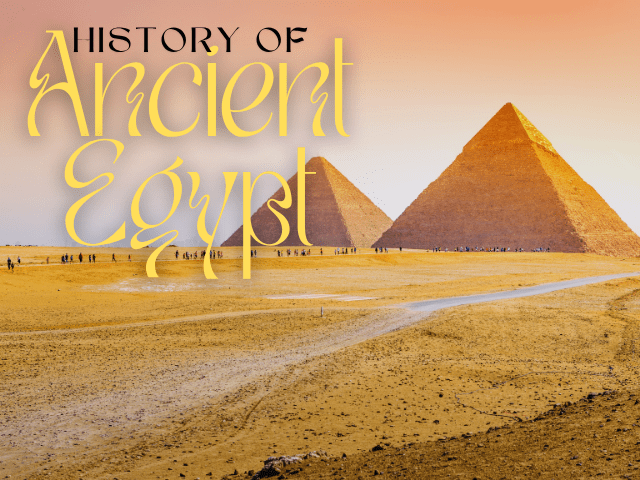
After building the Intro to Ancient Civilizations class for our students to build foundational knowledge of the ancient world, I decided I wanted to provide a more in-depth look into some of the civilizations we discussed in that course. This focused class on Ancient Egypt provides the first in-depth look into one of the civilizations covered in that class. This five week course dives into the ancient Egyptian civilization, beginning with Egyptian prehistory and ending with Roman conquest. We will be learning about everything from mummification to Macedonians!
CLASS FORMAT
No live classes—view lessons on YOUR schedule. In general, expect 1.5-2.5 hours to work through the lesson plan each week, and an additional 2-5 hours working on assignments (it really depends what assignment your child chooses to do and how they manage their time). For classes with two levels, the material is the same for both—the depth of the assignments differs. Younger students should usually be placed in Level 1. Older students, or younger students who want more of a challenge, should be placed in Level 2.
Each lesson consists of a fully narrated PowerPoint presentation with images and videos to enhance the topics. Students will have access to our learning management system, Canvas, for viewing their lesson, printing worksheets, taking quizzes, viewing/submitting assignments, participating in discussions, and viewing grades/feedback.
Week 1 – Prehistoric Egypt
The first week of the class acts mostly as an introduction as we ease back into studying ancient civilizations. We will be discussing how Egypt and other civilizations developed around rivers and were able to thrive as a result. Then, we will look at the earliest people to move into the Nile River basin, the founders of one of the most significant civilizations in the history of the world.
Week 2 – Old Kingdom
Week 2 is dedicated to the earliest kingdom of ancient Egypt. Though it is the oldest kingdom period in ancient Egypt, it is far from unremarkable or obsolete. We will be learning about the creation of the pyramids, the religion and the Pharaohs, and the process of mummification.
Week 3 – Middle Kingdom
While the Old Kingdom provided some of the most recognizable iconography in Egypt’s history, it was hardly the only significant time period. The section on the Middle Kingdom addresses some of the important leaders of the time, along with the art that was being produced. Finally, we will take a look at the common people living in Egypt and what their daily lives looked like.
Week 4 – The New Kingdom
The fourth week of the class moves on to the next Kingdom in our list. The lesson will be mostly based around the important rulers of the time and the decline of the ancient civilization. All is not lost though! Egypt still has one more period of major importance in the ancient world.
Week 5 – Hellenistic Egypt
After dominating the ancient Mediterranean world for thousands of years, Egypt faced a decline. The rich wheat fields of the Nile River became a prime target for new civilizations looking to carve out their place in the ancient world. First, the Greeks under Alexander the Great (a pharaoh in his own right) conquered the territory. This week focuses mostly on Egypt’s period under Hellenistic Greek rule. We finish out the semester with what is often considered the end of the ancient Egyptian civilization: conquest by the Romans.